


Manual Payroll vs Payroll Software
Manual Payroll vs Payroll Software: Which Is Better for Malaysian Businesses?
- What Is Manual Payroll?
Manual payroll involves calculating and managing employee salaries without dedicated payroll software.
Businesses may use:
- Excel spreadsheets
- Paper records
- Calculators
- Separate attendance records
- Manual payslip preparation
HR or finance teams typically calculate basic salary, overtime, allowances, deductions, leave, and other payroll components manually.
Manual payroll can work for a very small organisation with straightforward salary structures, but the workload increases as the workforce grows.
- What Is Payroll Software?
Payroll software Malaysia is a digital system designed to automate and manage payroll processes.
Depending on the platform, it can help businesses manage:
- Employee information
- Salary calculations
- Overtime
- Allowances
- Leave
- Deductions
- Statutory contributions
- Payslips
- Payroll reports
When payroll is integrated with attendance and leave management, businesses can reduce repetitive data entry and create a more connected HR workflow.
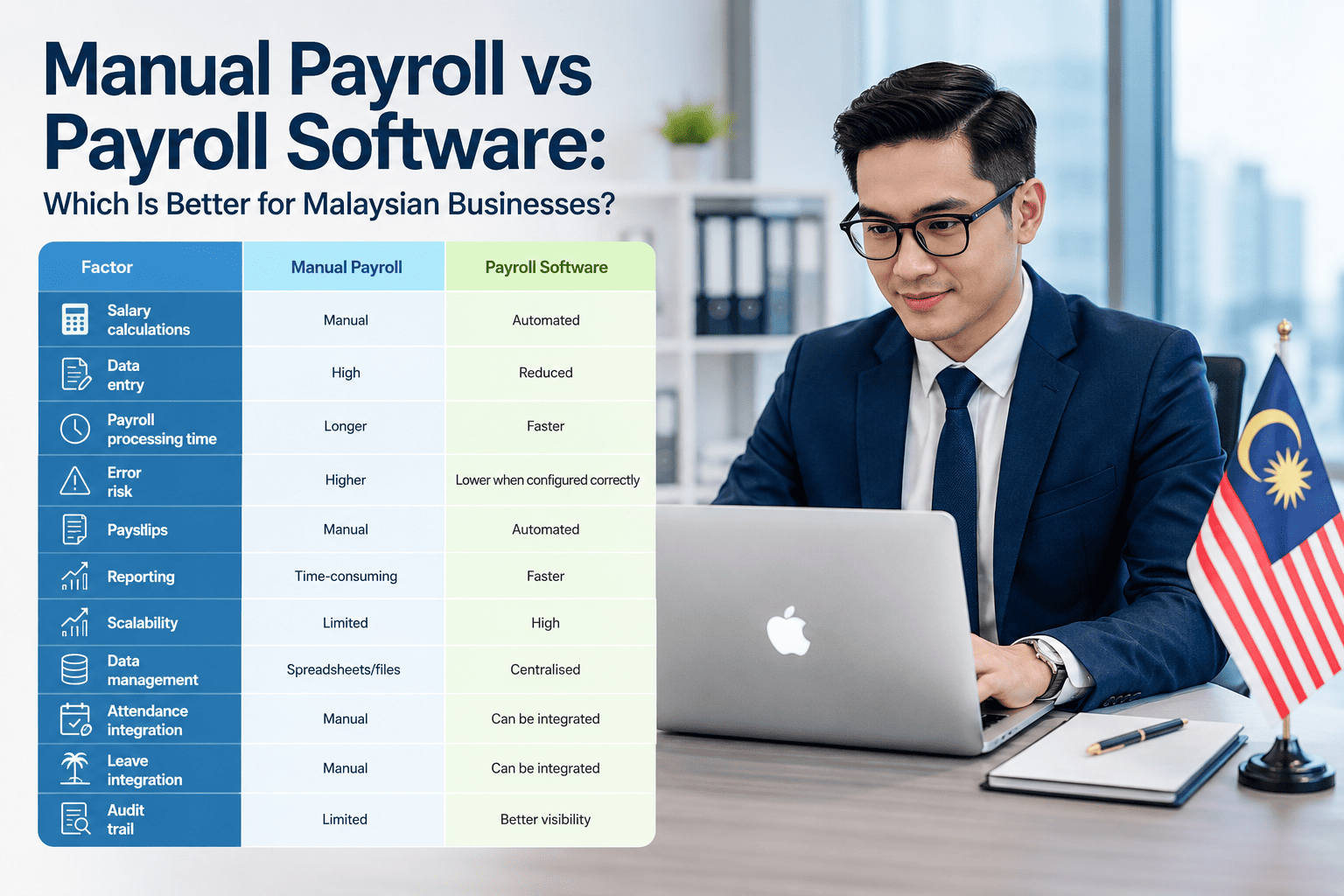
- Manual Payroll vs Payroll Software
Factor | Manual Payroll | Payroll Software |
Salary calculations | Manual | Automated |
Data entry | High | Reduced |
Payroll processing time | Longer | Faster |
Error risk | Higher | Lower when configured correctly |
Payslips | Manual | Automated |
Reporting | Time-consuming | Faster |
Employee self-service | Usually unavailable | Often available |
Scalability | Limited | High |
Data management | Spreadsheets/files | Centralised |
Attendance integration | Manual | Can be integrated |
Leave integration | Manual | Can be integrated |
Audit trail | Limited | Better visibility |
- What Features Should Malaysian Businesses Look for?
1. Payroll Accuracy
One of the biggest advantages of payroll software is reducing repetitive manual calculations. With manual payroll, HR teams may need to calculate:
- Overtime
- Allowances
- Unpaid leave
- Deductions
- Contributions
- Net salary
A small data-entry or formula error can affect an employee’s final salary. Payroll software can automate many calculations based on configured rules.
However, automation does not guarantee zero errors. Employee information, salary structures, system configuration, and statutory rules still need to be reviewed regularly.
2. Time and Productivity
Manual payroll can consume significant HR time every month.
The process often involves collecting attendance information, checking leave records, calculating salaries, preparing payslips, and generating reports.
With payroll software, many of these repetitive processes can be automated. For example:
Employee Data → Attendance → Leave → Payroll Calculation → Approval → Payslip
This connected workflow can significantly reduce administrative workload.
HR teams can then spend more time on recruitment, employee engagement, workforce planning, and other strategic activities.
3. Managing Malaysian Statutory Requirements
Payroll processing in Malaysia involves applicable statutory deductions and contributions. Depending on employee circumstances, employers may need to manage items such as:
- EPF
- SOCSO
- EIS
- Monthly Tax Deduction (MTD/PCB)
Manual payroll requires HR teams to maintain accurate calculations and keep up with applicable changes.
A suitable payroll management system Malaysia can help automate relevant calculations and reporting, provided the software is maintained according to current requirements.
Businesses should always verify that their chosen payroll provider supports the latest applicable Malaysian requirements.
4. Employee Payslips
Creating payslips manually can be repetitive, particularly for organisations with many employees.
Payroll software can generate digital payslips based on approved payroll data.
Employees may also be able to access their payslips through an employee self-service portal, depending on the system.
This reduces the number of routine requests HR teams need to handle.
5. Attendance and Leave Integration
This is where payroll software can provide a major advantage.
With manual payroll, HR may need to collect attendance and leave information separately and then transfer it into payroll calculations.
Integrated HR software can connect:
Attendance + Leave + Overtime + Payroll
This can reduce duplicated data entry and make payroll processing more efficient.
For businesses with shift workers or large teams, this functionality can be particularly valuable.
6. Payroll Reporting
Businesses need payroll information for accounting, budgeting, audits, and management decisions.
With spreadsheets, creating reports can require significant manual effort. Payroll software can provide structured reports covering areas such as:
- Salary expenses
- Employee payroll
- Overtime
- Deductions
- Contributions
- Department costs
This gives management better visibility into workforce expenses.
7. Data Security
Payroll contains sensitive information such as:
- Employee salaries
- Bank details
- Identification information
- Tax information
- Personal information
Storing this information across spreadsheets and individual computers can create management and security challenges.
Modern payroll platforms can provide features such as:
- User permissions
- Role-based access
- Authentication
- Secure backups
- Centralised data management
Businesses should evaluate the security practices of any payroll software provider before implementation.
8. Cost: Manual Payroll vs Software
At first glance, manual payroll appears cheaper because there is no dedicated software subscription.
However, businesses should consider the total cost of payroll processing. Manual payroll can involve:
- HR staff time
- Spreadsheet maintenance
- Error correction
- Repeated data entry
- Manual reporting
- Payslip preparation
- Compliance administration
As employee numbers increase, these costs can become significant.
Payroll software introduces a technology cost but can reduce administrative workload and improve efficiency.
The right choice depends on the company’s size, payroll complexity, and growth plans.
- When Does Manual Payroll Make Sense?
Manual payroll may still be reasonable for a very small business with:
- Few employees
- Simple salary structures
- Limited overtime
- Minimal payroll complexity
- Strong spreadsheet expertise
However, businesses should reassess this approach as their workforce grows.
- When Should a Business Switch to Payroll Software?
Consider switching when you experience:
- Increasing payroll errors
- Growing employee numbers
- Excessive HR workload
- Complex overtime calculations
- Multiple departments or locations
- Frequent payroll adjustments
- Difficulty generating reports
- Employee requests for digital payslips
These are signs that manual payroll may no longer be the most efficient solution.
- How iZem Can Help
iZem provides HR and payroll technology designed to simplify workforce management.
By connecting payroll with employee information, attendance, leave, and other HR processes, iZem can help businesses reduce repetitive administrative tasks and create a more organised payroll workflow.
For Malaysian businesses moving away from spreadsheets and manual processes, an integrated HR and payroll platform can provide a scalable foundation for workforce management.
- Frequently Asked Questions.
For growing businesses, payroll software generally provides better automation, scalability, reporting, and workflow integration than spreadsheets. Excel may still work for very small organisations with simple payroll requirements.
The cost varies by provider, features, employee count, and implementation requirements. Businesses should compare the software cost against the time and administrative costs of manual payroll.
Many Malaysian payroll systems support applicable statutory calculations. Businesses should confirm that their selected software is updated for current requirements.
Yes. Many modern HR platforms can connect attendance, leave, overtime, and payroll to reduce duplicate data entry.
No. Software reduces repetitive calculation and data-entry errors, but accurate employee information, configuration, updates, and payroll review remain essential.
- Looking for the best payroll software in Malaysia?
- Conclusion: Which Is Better?
So, manual payroll vs payroll software—which is better?
For a very small business with straightforward payroll, manual processing may initially be manageable.
But for growing Malaysian businesses, payroll software is generally the more efficient and scalable option.
It can reduce repetitive work, improve payroll accuracy, simplify reporting, integrate attendance and leave, and provide employees with easier access to payroll information.
As your business grows, moving from manual payroll to a reliable payroll software Malaysia solution can help HR teams spend less time processing salaries and more time focusing on people and business growth.