


How Does Payroll Software Work?
How Does Payroll Software Work? A Complete Guide for Malaysian Businesses
Payroll is one of the most important processes in any organisation. Every month, businesses need to calculate employee salaries, overtime, allowances, deductions, statutory contributions, and net pay accurately.
As businesses grow, handling these calculations manually can become time-consuming and difficult to manage. This is where payroll software Malaysia can help.
But how does payroll software actually work?
In simple terms, payroll software collects employee and payroll information, applies configured salary and deduction rules, calculates payroll, generates payslips and reports, and helps businesses maintain organised payroll records.
Let’s look at the process step by step.
- What Is Payroll Software?
Payroll software is a digital system that automates and manages employee salary processing. Depending on the platform, it can manage:
- Employee information
- Basic salaries
- Overtime
- Allowances
- Bonuses
- Leave
- Deductions
- Statutory contributions
- Payslips
- Payroll reports
Modern payroll platforms can also connect payroll with attendance, leave, and broader HR management.
This creates a connected workflow instead of requiring HR teams to move information between spreadsheets and different systems.
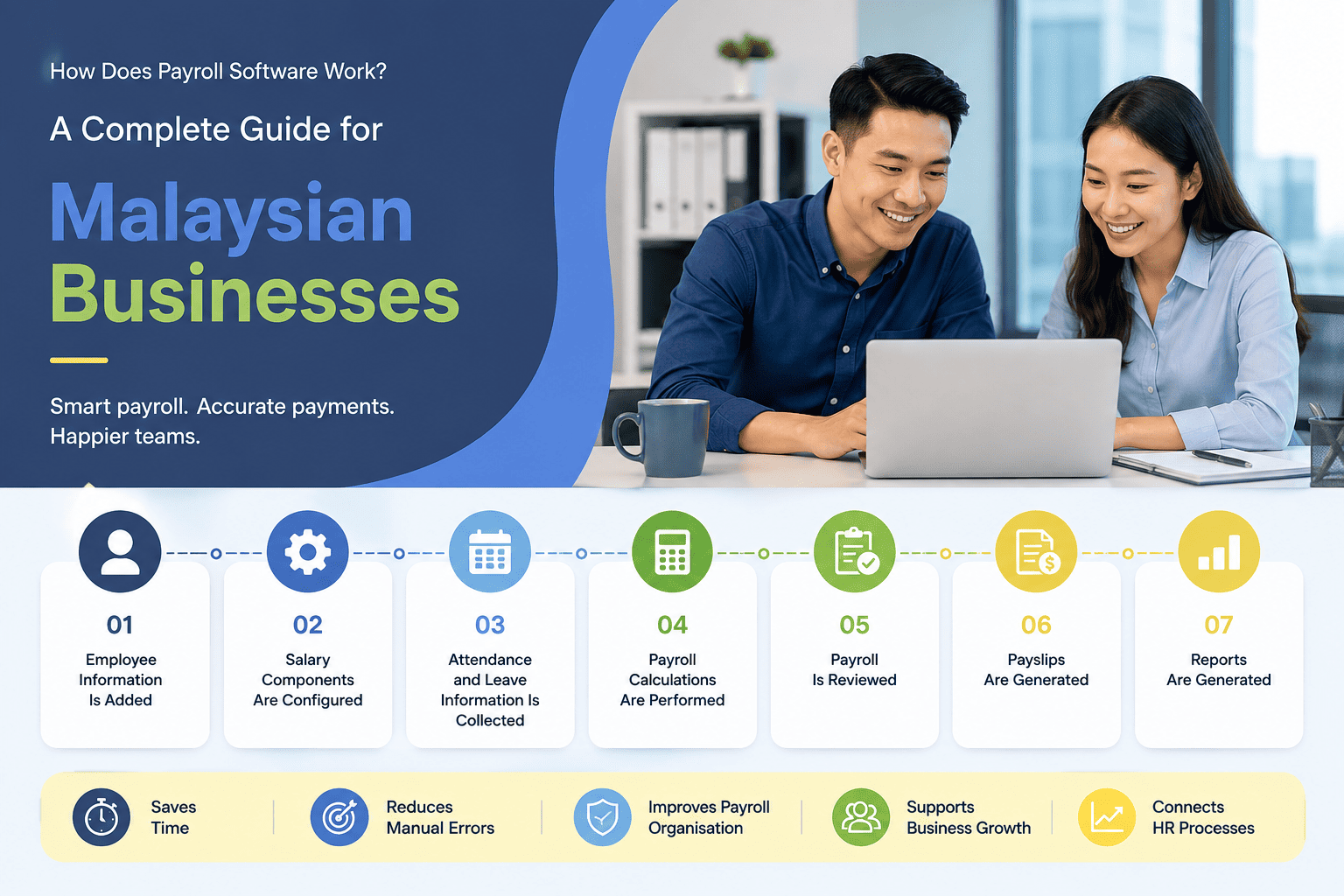
- How Does Payroll Software Work?
The payroll process typically follows several steps.
Step 1: Employee Information Is Added
The first step is creating employee profiles within the payroll system. Information may include:
- Employee name
- Identification details
- Employment information
- Salary
- Bank details
- Tax information
- EPF information
- SOCSO/EIS information
- Department
- Job position
Accurate employee data is essential because payroll calculations depend on this information.
Step 2: Salary Components Are Configured
The system is configured according to the company’s payroll structure. This may include:
- Basic salary
- Allowances
- Overtime
- Bonuses
- Commissions
- Deductions
- Unpaid leave
For example, if an employee receives a fixed monthly allowance, the system can apply that allowance automatically during payroll processing.
This reduces repetitive manual calculations.
Step 3: Attendance and Leave Information Is Collected
For businesses that use integrated HR software, attendance and leave information can flow directly into payroll.
For example:
Attendance → Overtime → Leave → Payroll
This is particularly useful for companies with shift workers or employees who regularly work overtime.
Instead of manually calculating overtime or checking separate attendance spreadsheets, the payroll system can use approved attendance information according to the configured rules.
Step 4: Payroll Calculations Are Performed
Once the required information is available, the system calculates employee payroll. Depending on the configuration, calculations can include:
Basic Salary + Allowances + Overtime + Bonuses − Applicable Deductions = Net Pay
The software can then apply relevant payroll rules and configured statutory calculations.
For Malaysian employers, this may involve applicable items such as EPF, SOCSO, EIS and Monthly Tax Deduction (MTD/PCB), depending on employee circumstances.
Businesses should ensure their payroll software is regularly updated to reflect applicable Malaysian requirements.
Step 5: Payroll Is Reviewed
Automation does not mean payroll should be processed without human review. Before finalising payroll, HR or finance teams should check:
- New employees
- Resignations
- Salary changes
- Overtime
- Bonuses
- Leave deductions
- Statutory calculations
- Unusual payroll changes
An approval process provides an additional layer of control and helps identify potential errors before salaries are processed.
Step 6: Payslips Are Generated
After payroll approval, the software can generate employee payslips. A payslip may include:
- Basic salary
- Allowances
- Overtime
- Deductions
- Statutory contributions
- Net salary
Depending on the platform, employees may be able to access their payslips through an
employee self-service portal.
This reduces routine HR requests and gives employees easier access to their payroll information.
Step 7: Reports Are Generated
Payroll software can also create reports for HR, finance, and management. Common reports include:
- Payroll summary
- Salary reports
- Overtime reports
- Deduction reports
- Department payroll costs
- Employee payroll history
These reports can help businesses understand workforce costs and support financial planning.
- What Are the Benefits of Payroll Software?
1. Saves Time
Automating repetitive calculations can significantly reduce the time HR teams spend processing payroll.
2. Reduces Manual Errors
Automated calculations can reduce errors caused by repeated data entry and spreadsheet formulas.
3. Improves Payroll Organisation
Employee information, payroll history, and reports can be maintained in one central system.
4. Supports Business Growth
A scalable payroll management system Malaysia can handle increasing employee numbers without requiring the entire payroll process to be redesigned.
5. Connects HR Processes
Payroll can be integrated with:
- Attendance
- Leave management
- Employee records
- HR reporting
This creates a more efficient HR workflow.
- Is Payroll Software Suitable for Small Businesses?
Yes.
Small businesses can benefit from payroll software because it reduces the administrative workload involved in salary processing.
As the business grows, the benefits become even more significant.
For example, a company processing payroll for 10 employees may manage manually without major difficulty. However, managing payroll for 100 or 500 employees using spreadsheets becomes considerably more complex.
The right software can scale alongside the business.
- Is Payroll Software Secure?
Payroll data contains sensitive employee information, so security should be a major consideration.
When selecting payroll software Malaysia, businesses should evaluate:
- Role-based access
- Authentication
- Data encryption
- Secure backups
- Access logs
- Data recovery
- Vendor security practices
Only authorised users should have access to sensitive payroll information.
- How iZem Helps Simplify Payroll Management
iZem provides digital HR and payroll solutions designed to simplify workforce administration.
By connecting payroll with employee information, attendance, leave, and HR processes, iZem helps businesses create a more organised payroll workflow.
Instead of relying on multiple spreadsheets and manual calculations, businesses can manage important employee and payroll information through a centralised system.
This can help HR teams reduce repetitive work, improve visibility, and manage payroll more efficiently.
- Frequently Asked Questions.
Payroll software uses employee information, salary structures, attendance, overtime, allowances, leave, deductions, and applicable configured rules to calculate gross and net salary.
Many payroll systems support applicable Malaysian statutory calculations. Businesses should confirm that their selected provider maintains current requirements and updates.
Yes. Many modern HR platforms integrate attendance with payroll so that approved attendance and overtime information can be used during payroll processing.
Many payroll systems provide employee self-service functionality, allowing employees to securely view or download payslips.
No. It reduces repetitive administrative work, but HR and finance teams still need to review payroll, maintain accurate employee information, approve changes, and ensure compliance.
- Looking for the best payroll software in Malaysia?
- Conclusion
So, how does payroll software work?
The process is straightforward:
Employee Data → Salary & HR Rules → Attendance & Leave → Payroll Calculation → Review & Approval → Payslip & Reports
By automating repetitive payroll processes, businesses can save time, reduce manual errors, improve payroll visibility, and create a more efficient employee management system.
For Malaysian businesses, choosing reliable payroll software Malaysia can be an important step toward modernising HR operations and supporting sustainable business growth.