


Self-Service Software
How Employee Self-Service Software Can Reduce HR Workload in Malaysian Companies
HR teams spend a significant amount of time responding to routine employee requests.
“Can you send me my payslip?”
“How many leave days do I have left?”
“Has my leave request been approved?”
“Can I update my personal details?”
These questions may seem simple individually, but when HR receives them repeatedly from dozens or hundreds of employees, they can consume a substantial amount of administrative time.
This is where employee self-service software Malaysia solutions can help.
Employee self-service, commonly called ESS, allows employees to access or manage certain HR information themselves instead of depending on HR for every routine request.
- What Is Employee Self-Service Software?
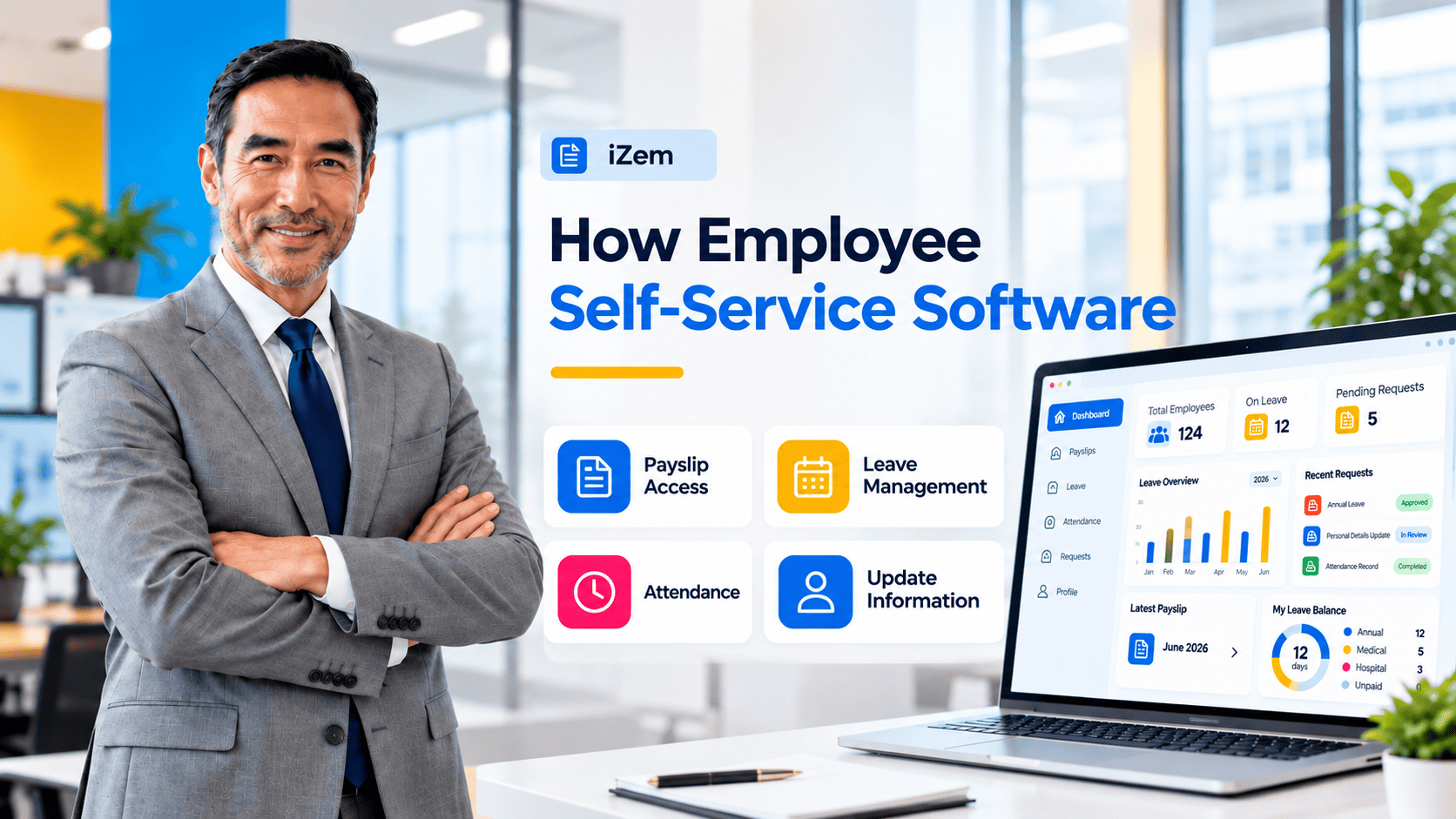
Employee self-service software is a feature of modern HR software Malaysia that allows employees to interact with their own HR information through a digital platform.
Depending on the system, employees may be able to:
- View payslips
- Check leave balances
- Apply for leave
- Check attendance
- Submit requests
- Update selected personal information
- View HR-related information
The purpose is not to remove HR from the process.
Instead, ESS helps HR teams spend less time handling repetitive requests and more time on higher-value HR activities.
- Why Do Malaysian Businesses Need Employee Self-Service?
As a company grows, the number of employee requests increases.
A business with 10 employees may be able to manage HR requests manually.
A business with 100 or 500 employees has a very different administrative workload.
Without an employee self-service system, HR teams may have to repeatedly:
- Receive an employee request
- Find the employee’s information
- Check the relevant record
- Prepare the response
- Send the information
- Update records if necessary
A self-service platform can move part of this process directly to employees.
1. Employees Can Access Their Payslips
Payslip requests are a common HR administrative task.
With an employee self-service portal, employees can access their available payslips digitally instead of asking HR to send them individually.
This can reduce repetitive HR communication and give employees faster access to their information.
2. Employees Can Apply for Leave Online
Manual leave requests can involve emails, messages or paper forms.
An integrated leave management system Malaysia solution can allow employees to submit leave applications digitally.
Managers can then review and approve requests through the system.
The result is a clearer process for:
- Leave applications
- Approvals
- Leave balances
- Employee records
3. Employees Can Check Attendance
Attendance information is particularly useful when employees need to review their working records.
Depending on the system, employees may be able to view attendance information through their employee portal.
This can reduce unnecessary HR queries and help employees identify discrepancies earlier.
4. HR Gets Fewer Routine Requests
The biggest benefit of employee self-service is often the reduction in repetitive HR administration.
Instead of answering the same questions repeatedly, HR can direct employees to the relevant information within the system.
This allows HR professionals to focus more on:
- Recruitment
- Employee engagement
- Performance management
- Training
- Workforce planning
- Policy development
5. Employee Information Can Stay More Organised
Employee self-service can also help keep employee information up to date.
Depending on the system and permissions, employees may be able to update selected details themselves.
For example, HR may allow employees to submit changes relating to contact information or other permitted records.
HR can then review and manage the information through the central system.
6. HR and Payroll Can Work Together
Employee self-service becomes even more useful when it is connected to payroll.
For example:
Employee → HR system → Attendance/Leave → Payroll → Payslip
When these processes are connected, information does not have to be manually transferred between multiple systems.
This is one reason businesses increasingly look for integrated HR and payroll software Malaysia rather than separate tools.
What Should You Look for in Employee Self-Service Software?
Not every ESS platform provides the same features.
Before choosing a solution, Malaysian businesses should consider:
Payslip Access
Can employees securely access their current and previous payslips?
Leave Management
Can employees apply for leave and check their balances?
Attendance
Can employees view relevant attendance information?
Approval Workflows
Can managers approve leave and other requests digitally?
Mobile Access
Can employees access the platform conveniently through supported devices?
Security
How does the provider protect employee information?
HR Integration
Can employee self-service connect with payroll, attendance and leave management?
Reporting
Can HR monitor employee activity and generate relevant reports?
Employee Self-Service vs Traditional HR Administration
Traditional HR Process | Employee Self-Service |
Employee asks HR for payslip | Employee accesses payslip |
Leave request through email/message | Leave request through system |
HR manually checks leave balance | Employee views available balance |
HR answers routine attendance queries | Employee checks attendance information |
HR updates every small employee detail | Employees can update permitted information |
Multiple communication channels | Centralised HR platform |
The goal is not to automate every HR decision.
It is to digitise repetitive administrative processes.
Is Employee Self-Service Suitable for SMEs?
Yes.
Employee self-service is not limited to large corporations.
For SMEs, it can be particularly useful because HR teams often have limited resources and may manage payroll, leave, attendance and employee administration simultaneously.
A simple digital system can help reduce repetitive work without requiring a large HR department.
How iZem Helps Businesses Digitise HR
iZem combines HR-related processes such as payroll, attendance, leave and employee self-service in a digital platform designed for businesses.
Instead of employees depending on HR for every routine request, self-service functionality can give employees more direct access to relevant information.
At the same time, HR can maintain greater visibility over employee records and related workflows.
This connected approach can help businesses reduce manual administration while creating a more structured employee experience.
How to Introduce Employee Self-Service Successfully
Technology alone is not enough.
Businesses should also make sure employees understand how to use the system.
A practical implementation process can include:
Step 1: Identify Repetitive HR Requests
Find out what employees ask HR most frequently.
Step 2: Select Relevant ESS Features
Start with high-volume processes such as payslips, leave and attendance.
Step 3: Configure Employee Permissions
Not every employee should have access to every HR function.
Set appropriate permissions based on roles.
Step 4: Train Employees
Provide simple instructions explaining how to access and use the system.
Step 5: Monitor Adoption
Track whether employees are actually using the self-service features.
Step 6: Improve the Workflow
Use employee feedback to identify areas that can be simplified further.
- Frequently Asked Questions.
Employee self-service allows employees to access or manage selected HR information themselves through a digital platform rather than contacting HR for every routine request.
Many HR and payroll platforms provide digital payslip access. Businesses should confirm the feature and security controls offered by their chosen provider.
Yes. Employee self-service platforms commonly allow employees to submit leave applications and check their leave balances.
It can reduce repetitive administrative requests by allowing employees to access information and submit routine requests themselves.
Yes. SMEs can benefit from reducing manual HR administration, particularly when a small HR team is responsible for managing many employees.
- Looking for the best payroll software in Malaysia?
- Conclusion
HR teams should not have to spend their entire day answering repetitive questions about payslips, leave balances and attendance.
Employee self-service software Malaysia can give employees direct access to relevant HR information while reducing routine administrative work for HR teams.
When ESS is connected with payroll, attendance and leave management, businesses can create a more efficient and centralised HR workflow.
For Malaysian businesses looking to move away from spreadsheets, emails and manual HR administration, an integrated HR platform can be an important step towards a more organised workforce.
Want to reduce repetitive HR work and give employees easier access to their information? Explore iZem and request a demo.